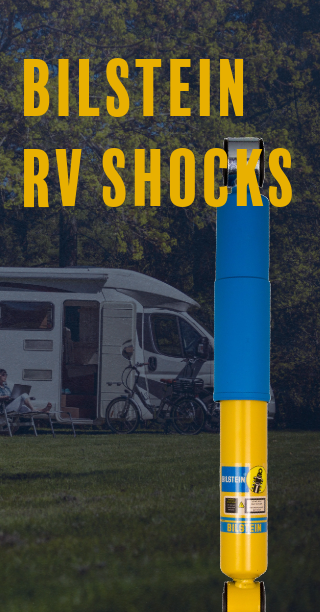
You Can Still Find Shocks Without a Standard Vehicle Lookup
Most shock shopping is straightforward. You enter your vehicle’s year, make, model, drivetrain, and other required details. The fitment lookup then displays compatible options from brands such as Bilstein, KYB, Monroe, FOX, Rancho, and KONI.
However, not every vehicle fits neatly into a standard year, make, and model search. You might own a classic car, an imported SUV, an older commercial truck, or a motorhome built on a separate chassis. Your vehicle may also have a lift kit, axle swap, custom brackets, or other suspension modifications.
If you need shocks for a vehicle not in the fitment lookup, an empty search result doesn’t necessarily mean compatible shocks aren’t available. You may need to search by chassis, original part number, mounting style, or physical dimensions instead.
Once you understand the measurements and mounting details that define shock fitment, the vehicle lookup is no longer your only option.
First, Your Vehicle May Be Cataloged Differently
Before assuming your vehicle isn’t covered, consider how its suspension parts may be listed. Shock manufacturers maintain applications for many classic cars, vintage trucks, motorhome chassis, commercial vehicles, and imported models. However, those applications aren’t always organized under the name you expect.
1. Your Vehicle May Be Cataloged by Chassis
This issue commonly affects motorhome owners. Winnebago, Tiffin, Newmar, Fleetwood, and other manufacturers build coaches on chassis supplied by another company.
Suspension parts are usually cataloged according to the chassis underneath the coach. Common examples include:
- Ford F-53
- Freightliner XC
- Workhorse W20 or W22
- Spartan chassis
- Chevrolet P30 or P32
The coach’s model year may also differ from the chassis year. Check the chassis identification label, VIN information, registration records, or owner documentation before searching.
Our guide to identifying your RV or motorhome chassis explains what information you’ll need.
2. Your Vehicle May Be Listed Under a Platform or Year Range
Older vehicles may be grouped by chassis code, platform, generation, or model-year range. Instead of searching only for one year, look for the broader vehicle generation.
You should also check for alternate model names. An imported vehicle may have been sold under a different badge or model designation in another market.
3. It May Require a Commercial-Truck Search
Medium-duty and Class 8 truck shocks are often cataloged differently from passenger-vehicle shocks. Fitment may depend on the truck model, axle configuration, axle rating, wheelbase, suspension type, or original equipment number.
If you have a commercial truck, record the make, model, year, axle rating, and number printed on the current shock. That information may be more useful than a standard vehicle lookup.
4. The Suspension May No Longer Match the Factory Configuration
A fitment catalog assumes the vehicle still has its original suspension geometry and mounting points. That assumption may not apply to a lifted truck, a restored classic, an off-road buggy, a resto-mod, or a vehicle with an axle conversion.
Modifications that can change shock fitment include:
- Lift or lowering kits
- Replacement or relocated shock brackets
- Axle swaps
- Leaf-spring conversions
- Coil-spring conversions
- Helper springs or air springs
- Custom control arms
- Long-travel suspension components
For these vehicles, you may need to select shocks based on length and mounting configuration rather than the factory application.
The Four Details That Determine Whether a Shock Fits
A shock absorber has several fixed dimensions and connection points. Four details are especially important when you can’t rely on a standard fitment listing.
Extended Length
Extended length is the shock’s overall mounting length when it’s fully extended. Depending on the mounting design, manufacturers may measure from eyelet center to eyelet center, eyelet center to stem shoulder, or another designated reference point.
The extended length must allow the suspension to reach its intended droop without the shock topping out. If the shock is too short, it may restrict down-travel or experience damaging extension forces.
Collapsed or Compressed Length
Collapsed length is the shock’s mounting length when it’s fully compressed. This measurement helps determine whether the shock can fit within the suspension’s available compression travel.
A shock that’s too long when compressed may bottom out before the suspension reaches its designed bump stop. That can damage the shock, its mounts, or nearby suspension components.
If the existing shock is known to fit correctly, you can remove it and compare its fully extended and compressed dimensions. Measuring actual suspension travel is more involved and should be handled by a qualified technician when the correct limits aren’t already known.
See our complete guide to finding shocks by length for more information about measurement points and travel.
Upper Mount Type
The upper shock mount may use an eyelet, stem, bar pin, crossbar, or another application-specific design.
- Eyelet: A round mounting loop containing a bushing and, in many cases, an inner sleeve.
- Stem or stud: A threaded post typically installed with bushings, washers, and a retaining nut.
- Bar pin: A metal pin that passes through the shock’s bushing and attaches at both ends.
- Crossbar or T-bar: A mounting bar or bracket secured with two fasteners.
Lower Mount Type
The lower mount requires the same careful identification. Don’t assume the upper and lower mounts match. A shock may use an eyelet on one end and a stem, bar pin, or crossbar on the other.
Even when two shocks have identical lengths, different mounting styles can make them completely incompatible. An eyelet and a bar pin may both use bolt-through attachment methods, but they aren’t interchangeable.
Our shock absorber mounting guide includes more information about eyelets, stems, bar pins, and other common designs.
Don’t Forget Bolt and Sleeve Dimensions
Matching the general mount style isn’t always enough. Two shocks may have the same length and eyelet configuration but use different bushing sleeves.
Check the following measurements when applicable:
- Mounting bolt diameter
- Bushing sleeve inner diameter
- Overall eyelet width
- Stem diameter and thread size
- Bar-pin or crossbar bolt spacing
A sleeve that’s too small won’t slide onto the mounting bolt. A sleeve that’s too large can create unwanted movement, even if the bolt passes through it.
For more help with these measurements, read our guide to shock bushing and mounting bolt sizes.
A Practical Shock-Measuring Routine
Before removing or measuring suspension parts, park on a level surface and follow the vehicle manufacturer’s lifting instructions. Use correctly rated jack stands and wheel chocks. Never work beneath a vehicle supported only by a floor jack.
- Photograph the installed shock and surrounding suspension from several angles.
- Take close-up photos of the upper and lower mounts.
- Record any visible manufacturer name or part number.
- Remove the old shock if it’s safe and practical to do so.
- Measure the old shock using the correct reference points for its mounting styles.
- Record its fully extended and fully compressed lengths.
- Identify the upper and lower mount types.
- Measure the mounting bolts, sleeves, stems, or crossbar spacing.
- Record any known suspension or axle modifications.
Don’t assume the old shock is correct simply because it was installed on the vehicle. Compare its dimensions with the available suspension travel, especially if the old shock bottomed out, topped out, leaked prematurely, or limited wheel movement.
What Information Helps Identify the Right Part Number?
When a catalog search doesn’t provide a clear answer, gather as much identifying information as possible.
- Vehicle year, make, model, body style, and drivetrain
- VIN or chassis information when applicable
- Motorhome chassis manufacturer, model, year, and GVWR
- Commercial-truck make, model, suspension type, and axle rating
- Original equipment or current shock part number
- Extended and compressed shock lengths
- Upper and lower mounting styles
- Bolt, sleeve, stem, or crossbar measurements
- Lift or lowering height
- Details about spring, axle, bracket, or suspension conversions
- Clear photos of the shock and both mounting points
Photos can be especially helpful. A clear image may reveal a bar pin, crossbar, offset eyelet, protective boot, or modified bracket that isn’t obvious from a written description.
Which Shock Brands Cover Unusual Applications?
Different manufacturers specialize in different vehicle types. Availability still depends on the vehicle and required dimensions, but several brands offer useful coverage beyond newer passenger cars.
- KYB: Offers shocks and struts for many domestic and imported passenger vehicles, trucks, and SUVs.
- Monroe: Provides broad passenger-vehicle coverage along with options for trucks, commercial vehicles, and motorhome chassis.
- Bilstein: Covers many cars, trucks, SUVs, off-road vehicles, and motorhome chassis. Certain Bilstein series also support lifted applications.
- KONI: Offers performance, heavy-duty, and motorhome shock applications.
- FOX and Rancho: Provide options for many off-road and lifted-truck applications.
- Gabriel: Offers coverage for various passenger vehicles, older trucks, vans, and commercial applications.
A brand name alone doesn’t determine fitment. The shock still needs the correct length, travel, mounting configuration, and damping characteristics for the vehicle.
What If the Shocks Already Arrived and Don’t Fit?
Stop before installing or modifying the shocks. Don’t enlarge a bushing sleeve, grind a mount, bend a stem, or force the shock into place unless the manufacturer specifically approves that procedure.
Keep the parts clean and retain all packaging, hardware, and documentation. Record the order number and part numbers received. Then photograph the fitment problem and identify exactly what doesn’t match.
Useful details include:
- The shock is too long or too short
- The upper or lower mount is incorrect
- The bolt doesn’t fit through the sleeve
- The eyelet is too wide for the bracket
- The stem has the wrong diameter or thread
- The crossbar holes don’t match the vehicle
You can use the ShockWarehouse return request form to review return eligibility and start the return or exchange process.
Get Help Finding Shocks for an Unlisted Vehicle
An empty fitment search doesn’t have to end your project. The right measurements, mount details, part numbers, and photos can help identify compatible shocks for classic cars, vintage trucks, motorhomes, commercial vehicles, imports, and modified builds. Gather the information listed above, then talk to our sales team for help matching your vehicle to the right part number. You can call 1-800-245-7469 or 1-954-202-6229 from 10:00 a.m. to 4:30 p.m. Eastern, Monday through Friday.